Veneers are one of the most effective ways to change how your smile looks, and also one of the most permanent. At Longo Dentistry on Dundas Street in London, Ontario, we place porcelain and composite veneers for adults who want to fix chipped, stained, worn or uneven teeth. This page explains how veneers work, how they compare with bonding and Invisalign, and when we would recommend something else.
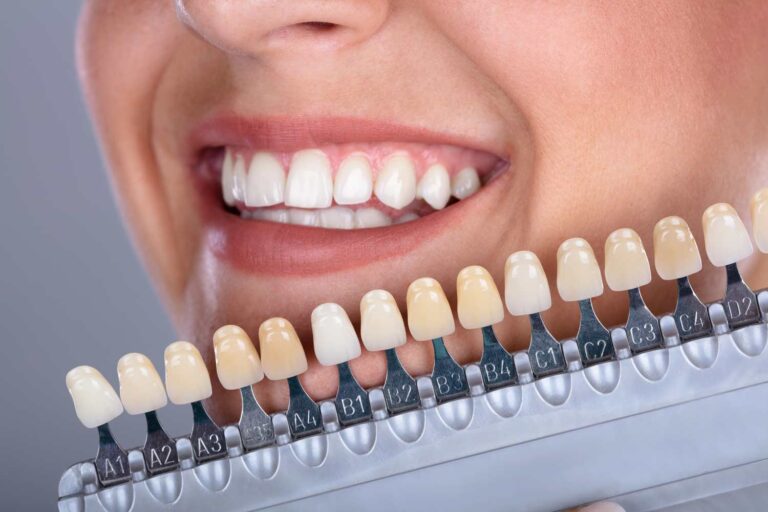
A veneer is a thin shell that covers the front surface of a tooth. It changes the tooth’s colour, shape and length, and can close small gaps. Veneers are custom-made to match the teeth around them, so a well-made veneer looks like a natural tooth rather than a cap.
Veneers are cosmetic. They do not straighten teeth, treat gum disease or fix a bite problem. If your teeth or gums need work first, we will tell you, and we will handle that before talking about veneers.
Porcelain veneers are made in a dental lab from a thin ceramic. They resist staining, reflect light the way natural enamel does, and typically last 10 to 15 years with good care. Placing them usually means removing a thin layer of enamel, so the decision is permanent: once a tooth has been prepared for porcelain, it will always need a veneer or crown.
Composite veneers are made from tooth-coloured resin, shaped directly on your teeth in the chair, often in one visit. They need little or no enamel removed, cost less, and are easier to repair. The trade-off is that they stain more easily and usually last 4 to 8 years before they need polishing, repair or replacement.
Neither is the “better” option across the board. Porcelain is usually the right choice for a full smile change you want to last; composite is often the right choice for one or two teeth, for younger patients, or for anyone who wants a reversible first step.
Bonding and composite veneers use the same material. The difference is coverage. Bonding repairs part of a tooth: a chipped corner, a small gap, one discoloured spot. A veneer covers the whole front surface.
If you have one chipped front tooth, bonding is usually enough, and it is quicker and less expensive. If several teeth are stained, worn or uneven, veneers give a more consistent result. We often start with bonding and only suggest veneers if bonding will not get you where you want to be.
Veneers can disguise mild unevenness, but they do not move teeth. Using veneers to hide crowding often means removing more enamel than necessary, which shortens the life of the veneers and the teeth underneath.
For crowded or rotated teeth, a few months of Invisalign first usually gives a better and more conservative result. Some patients find that once their teeth are straight, whitening or a little bonding is all they need. If that is you, we will say so. Read more on our Invisalign page.
Veneers suit adults with healthy teeth and gums who want to change the colour, shape or length of their front teeth and are comfortable with a permanent change. They are a weaker fit for anyone with untreated decay or gum disease, heavy grinding, crowded teeth that could be straightened instead, or teenagers whose teeth and gums are still changing.
You are likely a good candidate if:
You are likely a weaker candidate if:
We do not publish prices online because the cost depends on your teeth, not a menu. What drives the number you will hear at your consultation:
Veneers are one of our cosmetic dentistry services, alongside whitening, bonding, implants and Invisalign.
For the right patient, yes. Veneers can change a smile in two or three visits and last 10 to 15 years in porcelain. They are not worth it if a simpler option like whitening, bonding or Invisalign gets you the result you want, because porcelain veneers remove enamel permanently.
Porcelain veneers typically last 10 to 15 years. Composite veneers typically last 4 to 8 years. Grinding, biting hard objects and skipping cleanings shorten both.
Porcelain veneers usually need a thin layer of enamel removed, which cannot be undone. Composite veneers need little or no enamel removed. The tooth underneath stays healthy if it is cleaned and checked regularly.
Usually not, because veneers are cosmetic. A plan may cover a veneer that restores a tooth damaged by trauma or decay. The Canadian Dental Care Plan does not cover cosmetic veneers.
Porcelain lasts longer and resists staining. Composite costs less, is reversible and can be done in one visit. The right choice depends on how many teeth, your budget and how permanent you want the change to be.
If your teeth are crooked, Invisalign moves them; veneers only cover them. Straightening first often means fewer veneers or none at all.
Preparation for porcelain is done with local anaesthetic, like a filling. Some patients have mild sensitivity for a few days. Composite veneers often need no freezing.
Longo Dentistry, 1221 Dundas Street, Unit 1, in Old East Village. Saturday appointments and one weekday evening. Call (519) 455-1221.
Come in, tell us what you want to change, and get an honest opinion on whether veneers are the right tool. Longo Dentistry, 1221 Dundas Street, Unit 1. Call (519) 455-1221 or book online.